
Maintain Profitability During Periods of High Inflation With These 5 Expert Tips!

It seems there’s no end in sight for staggering inflation rates. As of October 2022, inflation came in at 8.2% YOY, maintaining its unprecedented rate of greater than 7% for just shy of a year.
Companies are experiencing rising costs and overall profit loss due to inflation. How they handle this determines success or failure during periods of high inflation. While you could raise prices across the board, this approach is blunt and will likely hurt margins overall.
Here’s everything you need to know regarding reconciling pricing with inflation. These 5 strategies will help you maintain customer trust and loyalty while keeping profits stable.
- Shift Discounts and Promotions
During periods of high inflation, companies focusing on total product and customer profitability will do better than those focusing only on cost changes. Accompanying this strategy is often a pocket-price-waterfall approach to help assess the revenue of each transaction.
Pocket price refers to a customer's effective price after all promotions, rebates, and discounts.
A famous McKinsey study showed that one lighting supplier received an invoice price an average of 32.8% lower than the list price, and off-invoice discounts meant a pocket price that was only half of the list price. Yikes!
That lighting supplier isn’t an isolated incident, merely an example of what can happen when you don’t discount strategically based on data.
Pocket price waterfalls show “profit leakage” at every sale step. This helps companies understand why some customers and/or goods are profitable, and others are not.
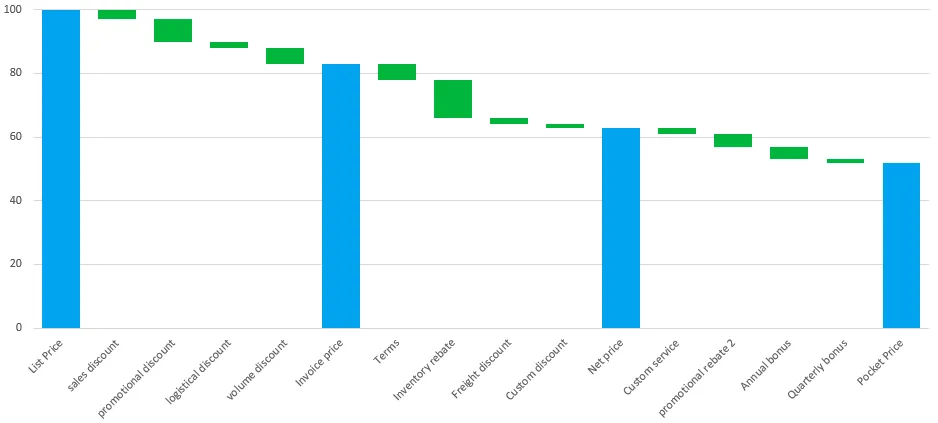
It’s important to understand that discounts and promotions have their place, but especially during high inflationary periods, you must track them carefully.
You’ll also need to maximize profit through means that aren’t pricing. For instance, if a manufacturing company experiences higher demand than supply with high costs on low-volume products, they could lengthen lead time on all products to enable efficient scheduling. Sales teams can empower customers to opt for standard alternatives. All this can increase productivity and keep margins steady without a price increase.
- Base Price Changes in Careful Thought
Broad price increases are easy, but they’re detrimental. How customers react to a price increase varies tremendously based on their price sensitivity. Thus, price increases across the board can erode customer trust and cause you to come across as insensitive to customer needs.
The alternative to an overall price increase is adjusting tactically based on each product and customer segment. Here are three analytics to look at when determining how to raise prices:
- Customers’ end-to-end profitability
- Margin performance based on the price change
- Customers’ willingness to pay as compared to peers
Based on this data, adjust prices only for specific products and certain customer segments.
Retailers are a strong example of this. The majority of retailers have primary, secondary, and tertiary goods.
Take grocery stores: primary goods are staples such as bread, pasta, milk, and eggs. Secondary goods might include cheese, yogurt, jams, jellies, and cereals. And tertiary goods could be condiments, spices, and seasonings.
Remaining competitive on key-value items such as bread and eggs will help grocers stay competitive while they increase prices on secondary and tertiary items. People buying these items are often less price-sensitive; this allows those who depend on food staples to remain unaffected by price increases while grocers make up profits on other items.
3. Decide Much Faster
Increasing prices in response to inflation is rarely done once. These decisions come with expected and unexpected consequences, requiring a dedicated council that acts quickly to manage price changes.
Pricing decision-makers need the power to react fast and adjust based on customer and market feedback. They need to view customer responses in real time, track the impact of price adjustments, and shift prices accordingly.
Some more specific data companies can look for include:
- Market conditions
- Performance
- Business reviews
- Customer interviews
- Competitor price changes
Do you have the right team of pricing experts in place to react quickly and optimize your pricing strategy? Jennings Executive can help you find senior-level pricing experts that ensure your company reacts fast and maximizes profit. Learn more today!
- Make Adjustments Elsewhere
Price adjustments are one way to make up for inflationary loss, but they aren’t the only way. Companies that succeed can make up for inflation elsewhere without impacting the customer.
First, companies must be ruthless in tracking the efficiency of their business. This overview will give you a better idea of where you can effectively cut costs. Ensure your balance sheet and budget are highly accurate and updated based on inflation.
You’ll also want to negotiate with vendors. Price shop and compare all vendors in your business.
Additionally, stop manufacturing products that aren’t selling well. Periods of high inflation mean focusing your efforts on the most profitable goods and services.
Eliminating turnover and hiring the right people is also highly critical. A bad hire can cost as much as 30% of their first-year earnings, which is even more expensive at the senior levels.
Need help finding the right senior-level talent to avoid the cost of a bad hire? Jennings Executive would love to work with you.
- Continuously Track Your Execution
Unless you track execution relentlessly, there’s no way to know if your efforts are prevailing. Companies need to establish leading and lagging indicators that can guide pricing decisions. These indicators may include customer surveys, cost indices, or competitor decisions.
Tracking execution as thoroughly as possible means transparency and a higher degree of performance. Don’t delay, and start monitoring key analytics today.
The Rest is Up To You
We hope these strategies help you make strategic pricing adjustments to maintain profitability.
If you need the right pricing strategy team to help you execute, Jennings Executive has decades of experience and would love to find the right talent for you. Contact us today to get started!
Related: What is an Executive Search Firm? Here’s Everything You Need to Know
Recommended For You

Your 2027 Plan Assumed Interest Rate Cuts. You Got a Hike
Plans drafted on rate cuts met a hike. Four hiring assumptions that quietly broke.

Your 2027 Plan Budgets for Nobody Good Leaving
Merit budgets are flat at 3.5%. The pool that retains leaders is 0.5%. Fix it now.

The CFO Bench Ran Out. That Is Why Hires Are Younger.
CFO hires are younger because the experienced pool ran dry. Four signals of readiness.

The CTO Spec That Fails Is Usually Two Jobs
These three roles are not a ladder. Four questions that reveal which one you need.

PE Firms Screen for Pedigree and Fire for Tempo
PE hires fail on tempo, not credentials. Three signals that test decision speed in the room.
Your Brand Scorecard Improves When You Cut Price
Brand measurement tells you the premium you earned. It won't tell you how much you kept.

